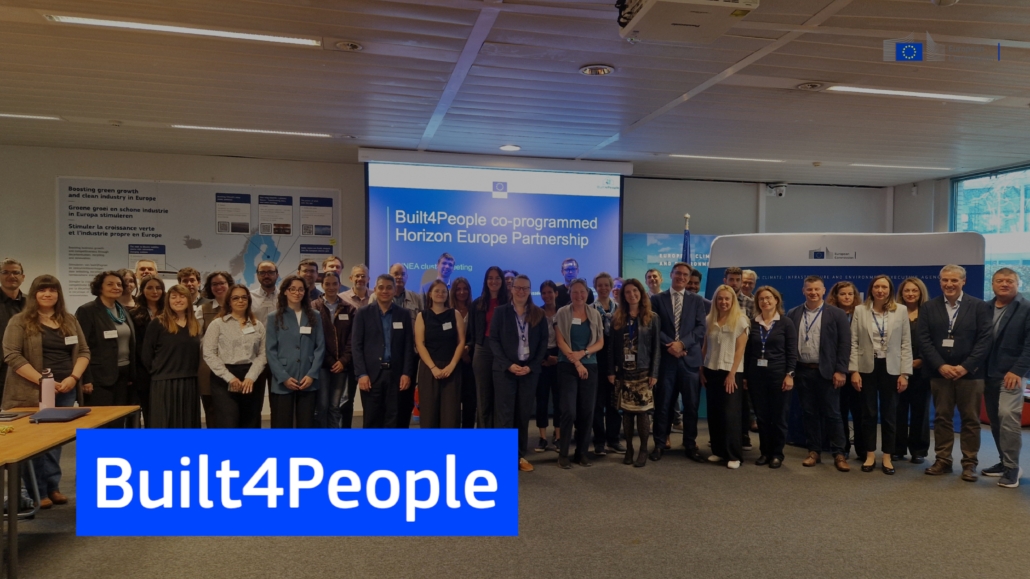
Built4People Projects Clustering Event: Strengthening Collaboration Across the Built4People Community
On 6 October 2026, the Built4People Projects Clustering Event, organised by CINEA, with the support of the European Commission, ECTP and ENCORD, took place in Brussels within the framework of the Built4People (B4P) partnership. This annual event brings together representatives from projects funded under the Built4People calls to strengthen collaboration across the community, foster knowledge exchange and facilitate networking. It provides a valuable opportunity for participants to share experiences, discuss common challenges, exchange lessons learnt and showcase good practices developed through their projects, helping to maximise synergies and strengthen the collective impact of the Built4People partnership.
Introduction and welcome
The event opened with a welcome address by Martin Lange, Head of Unit at CINEA C2, who highlighted CINEA’s role in supporting green growth and clean industries through the management of EU funding programmes, including Horizon Europe, the Innovation Fund and the LIFE Programme, among others.
Representing the private side of the Built4People partnership, Anastasiya Yurchyshyna, ECTP Secretary General, encouraged participants to strengthen collaboration and co-creation across the community to address challenges facing the built environment and shape the partnership’s future. Magnus Österbring, Secretary General of ENCORD, echoed this message, stressing the need to move beyond isolated initiatives and pilot projects towards a more connected innovation ecosystem that brings together the expertise of Europe’s construction industry and helps scale up innovative solutions.
Together, the opening contributions set the tone for the day, highlighting the importance of collaboration in accelerating innovation and maximising its impact across Europe.
Policy update
Barbara Pirchner, Policy Officer at DG ENER, provided an update on the implementation of the recast Energy Performance of Buildings Directive (EPBD), highlighting the May 2026 transposition deadline and the upcoming National Building Renovation Plans, due by the end of the year. She also presented the Electrification Action Plan, adopted in July 2026, and its measures to support heat pumps and district heating and cooling.
The presentation also addressed the next EU Multiannual Financial Framework (MFF, 2028–2034) and the future FP10 research and innovation programme. European Partnerships are expected to remain key instruments, with a simpler structure, more strategic priorities and greater emphasis on private-sector contributions. The proposals are still subject to legislative negotiations.
The Built4People Innovation Clusters Network | STAR*track project
Claudia Hunziker-Keller (Nobatek) presented the STAR*track project, a Coordination and Support Action (CSA) supporting the growth of the Built4People Innovation Clusters (B4PIC) Network. The network currently comprises 29 Emerging and 5 Prospective B4PICs, with the ambition of establishing 10–15 fully operational B4PICs by 2028 to strengthen collaboration between industry and research and accelerate the market uptake of Built4People innovations.
She also highlighted key tools supporting this ecosystem: the Metabuilding platform, connecting construction and related sectors to share innovations, find collaboration partners, showcase solutions and access R&D, testing and certification support; and the Maturoscope, which helps assess technological maturity and market readiness. Through the B4PIC Network, projects can also access testing facilities, demonstration sites, funding opportunities and innovation support services, helping them build synergies and bring their solutions closer to market.
Project presentations: The newcomers
The event also featured presentations of recently funded Built4People projects, showcasing innovative approaches to sustainable renovation, robotics, digitalisation and circular construction.
Industrialisation of sustainable, circular deep renovation
SPHEERE – Presented by Sudhanshu Verma
SPHEERE introduces a prefabricated renovation approach combining technological and circular solutions to make deep building renovation faster, more affordable and less disruptive, while improving energy efficiency and reducing emissions.
FRAIMwork – Presented by Lorenz Van Damme
Focusing on small-scale European buildings, FRAIMwork combines modular prefabricated elements with BIM-based digital tools to simplify deep renovation, reduce on-site work and lower costs and construction waste.
Robotics for construction, renovation and maintenance
ShieldBot – Presented by Iker Mancisidor
ShieldBot brings robotics to building renovation, combining solutions for interior works, exterior inspections and façade insulation. Its digital twin and sustainable insulation technologies aim to improve energy performance while reducing environmental impacts.
RADIANCE – Presented by Gálata Martínez
RADIANCE integrates robotics, artificial intelligence (AI) and digital technologies throughout the renovation process, from building inspection to repair. By combining autonomous systems with AI-based defect detection and digital twins, the project seeks to make renovation safer, faster and more sustainable.
RoboCons – Presented by Andoni Amurrio
RoboCons is creating a human-centred construction ecosystem that combines robotics, AI, Building Information Modelling (BIM) and other digital tools. Its approach aims to improve safety, productivity and quality while reducing costs, waste and environmental impacts.
BIM-based processes and digital twins for circular energy renovation
INTEGRATES – Presented by Cristian Pozza
INTEGRATES connects BIM, digital twins and data-driven services through accessible digital tools designed to support energy-efficient and circular renovation. Digital Product Passports and Digital Building Logbooks are among the solutions intended to facilitate material reuse and improve decision-making, including for SMEs.
DTERBIM – Presented by Sonia Álvarez Díaz
DTERBIM is developing an open, interoperable BIM-based framework incorporating AI services and digital twins. By improving data exchange and collaboration across the building lifecycle, it aims to optimise resources, reduce costs and time, and integrate circularity into renovation processes.
Design for adaptability, re-use and deconstruction of buildings
CRedIBlE – Presented by Sofia-Natalia Boemi
CRedIBlE combines BIM, life-cycle assessment (LCA), digital twins and AI to support circular building design. Its digital tools, including Digital Product Passports and modular design solutions, help make buildings more adaptable and easier to disassemble and reuse materials from.
Digital solutions to foster participative design, planning and management of buildings, neighbourhoods and urban districts
RenoVisor – Presented by Máirtín Ó Méalóid
RenoVisor helps citizens, homeowners and energy communities make informed renovation decisions by combining building simulations, social science and participatory advisory tools. It aims to clarify renovation costs, benefits and impacts while supporting more affordable, comfortable and inclusive outcomes.
BLUEPRINT – Presented by Léa Faure
BLUEPRINT combines digital technologies, including multi-scale digital twins, AI and augmented reality, with participatory approaches inspired by New European Bauhaus values. Its goal is to support inclusive urban regeneration, ensuring that digital innovation is complemented by accessible, low-tech ways for communities to participate.
Breakout Sessions
Session A: Discuss the projects’ results and innovations in relation to the four strategic action pathways of the Built4People partnership
Facilitated by Anastasiya Yurchyshyna (ECTP), Vedran Angebrandt (CINEA) and Cornelia Partsch (ECTP), the first breakout session explored how Built4People projects contribute to the partnership’s four Strategic Action Pathways: Net-Zero, Affordable, Resilient and Productive Built Environment.
Discussions highlighted the diversity of solutions emerging across the community, from circular construction materials and heritage renovation to robotics, digitalisation and inclusive urban regeneration. Participants also identified common challenges, including bridging the gap between research and market uptake, improving data sharing and facilitating collaboration across disciplines.
Three priorities emerged for future collaboration: establishing a common language across disciplines, involving more start-ups alongside SMEs, and addressing industrial partners’ concerns about data sharing. These insights highlighted the importance of closer cooperation to turn project results into scalable solutions.
Session B: Explore how the results from projects can inform policies and the future MFF
Facilitated by Bogdan Atanasiu (CINEA), Veronika Schröpfer (CINEA) and Nerea Gómez (ECTP), the second breakout session examined how Built4People project results can inform policymaking and future priorities under the EU MFF and research and innovation programmes. Discussions focused on renovation as a key driver for addressing climate objectives, energy security, housing affordability and resilience.
Participants highlighted the potential of digitalisation, AI, robotics and industrialised renovation to reduce costs and implementation times. Better access to reliable building data, interoperable tools and circular material markets could further improve efficiency and resource use. However, solutions must remain adaptable to Europe’s diverse building stock and consider factors such as durability, accessibility and climate resilience.
Beyond technology, the discussion stressed the need for effective financing mechanisms, skilled workers, supportive regulatory frameworks and greater engagement with homeowners, tenants and social housing providers. Participants also emphasised the importance of building on existing project results and accelerating their uptake. Future EU research and innovation programmes should therefore support not only the development of new solutions, but also the market conditions and practical capacity needed to deploy them at scale.
Closing of the event
The event concluded with closing remarks from Annarita Ferreri, Head of Sector for Energy Efficiency and Smart Cities at CINEA, and Veronika Schröpfer, who thanked participants for contributing to another successful edition of the Built4People Projects Clustering Event. They highlighted the value of the discussions, knowledge exchange and networking throughout the day, reinforcing the importance of collaboration across the Built4People community to turn project results into practical solutions and accelerate the transition towards a more sustainable, resilient and people-centred built environment in Europe.