Tag Archive for: EU Project Collaboration

WILSON – Distributed data modelling and Federated Digital Twinning for lifecycle data-driven sustainable operation and management of buildings and districts

About the Project:

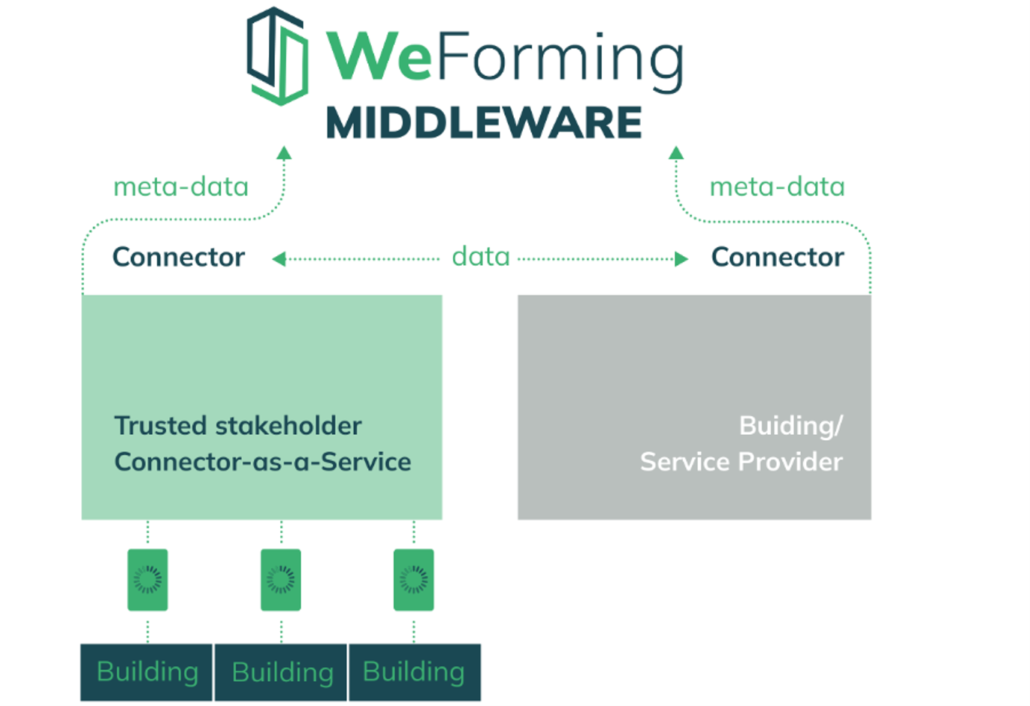
The built environment faces mounting pressures from climate change, resource scarcity, and the need for sustainable development across the full lifecycle of buildings. Yet, fragmented and siloed data within Building Management Systems (BMS) limits the effective use of lifecycle information for informed sustainability decision-making. WILSON addresses this challenge by introducing a transformative approach built on semantic data repositories, cognitive digital twins, and decentralised data management. Through a holistic and extensible data mesh architecture, the project ensures interoperability with existing proprietary BMS and Digital Twin systems while enabling improved building operations, environmental impact assessment, circularity evaluation, and advanced diagnostics. Central to this ecosystem are Personalised Building Data Hubs (PDHs), which apply International Data Space (IDS) principles to enable trusted data exchange and service transactions via a P2P marketplace.

Complementing these technological solutions, WILSON will deliver an Investment Tool providing stakeholders with detailed insights to guide decisions regarding building operation, renovation, and uptake of sustainable assets. To maximise its relevance and impact across Europe, the project’s integrated solutions will be validated in four large-scale pilots representing diverse contexts: a public district in Italy, a coastal hospital in Spain, an urban mixed district in the UK, and a rural residential area in Switzerland.

Press Release #7 – WILSON & UPSCALE Projects Announce Joint Workshop on Data Spaces for Construction

The WILSON and UPSCALE Projects will host the international “Data Spaces for Construction” workshop at TU/e on 21 May 2026, bringing together experts from research, industry, technology, and policy to advance interoperable, secure, and sovereign data sharing across the built environment. The event will explore essential components of construction-focused data spaces, such as reference architectures, governance and trust frameworks, semantic standards, and technical integration layers, through three parallel hands-on sessions covering business readiness, governance models, and scalable technical architectures. Concluding with a synthesis plenary, networking forum, and reception, the workshop aims to strengthen collaboration and shape a shared roadmap that accelerates the adoption of open, trustworthy, and interoperable data spaces, supporting Europe’s move toward more circular, digital, and climate‑neutral construction ecosystems.

For more information: https://wilson-project.eu/wilson-press-release-v7/

Recent Publications

WILSON’s latest publications showcase the project’s advancements in intelligent, interoperable, and sustainability‑driven solutions for the built environment. The first explores how adaptive and general‑purpose AI can better leverage complex building data to move beyond fixed-purpose automation. The second introduces a domain‑specific Vocabulary Hub that enhances semantic data exchange and interoperability across AECO data spaces. The third presents a hybrid assessment method for evaluating the impacts and benefits of nature‑based solutions in urban systems.

For more information: https://wilson-project.eu/publications/  

Innovation in action: strengthening climate resilience in Europe’s built environment

As climate risks intensify across Europe, improving the resilience of the built environment is becoming increasingly important. From extreme heat and flooding to other natural hazards, buildings, districts and urban systems must be better prepared to withstand and adapt to these challenges. 

Through its engagement with EU-funded projects, STAR*track is identifying and showcasing innovations that are being developed, tested and deployed across Europe.   

This article brings together a growing portfolio of climate resilience-focused solutions that aim to address the challenge from different angles, from digital planning systems to early warning protocols. 

Please note: This page will be updated regularly as additional projects and innovations are added.  

Featured climate resilience projects and innovations: 

Minority Report– Renovation Road Mapping Decision Support System (DSS) 

Innovation type: Software 

Innovation development status: Under development. TRL 6 

A digital renovation planning platform that: 

  • Helps planners, architects, engineers and building professionals plan and optimise renovations 
  • Supports climate resilience and energy efficiency improvements at the district scale 
  • Facilitates collaboration between multiple stakeholders involved in renovation planning 
  • Provides digital decision-support throughout the renovation process 

Learn more about Minority Report. 


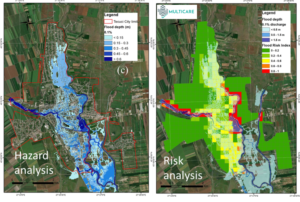
MULTICARE – Flash-Flood Early Warning Protocol for Tecuci City 

Innovation Type: System / Technology 

Innovation Development Status:Under development – TRL 6–7, validated in a relevant environment at the Tecuci pilot site (Romania). 

A digital data driven early warning system that: 

  • Enhances preparedness and minimises the impact of flash flood risks 
  • Integrates real-time river and rainfall sensors with European weather models  
  • Uses AI-assisted hydrological and hydraulic forecasting to predict flood scenarios 
  • Provides automatic alerts and visual dashboards for city operators and first responders 
  • Is designed with a modular structure enabling replication in other European cities exposed to flood and climate hazards 
Learn more about MULTICARE. 


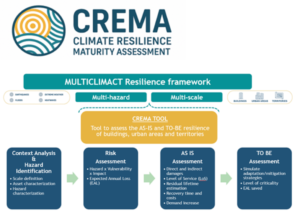
MULTICLIMACT  CREMA Tool (Climate Resilience Maturity Assessment) 

Innovation type: Software, System, Technology  

Innovation development status: Under development, TRL6-7  

A climate resilience assessment tool that: 

  • Conducts comprehensive risk and resilience assessments across various scales, including buildings, urban areas, and entire territories  
  • Empowers decision-makers to evaluate the resilience of assets including cultural heritage sites, urban sectors, and regional amenities  
  • Applies probabilistic and deterministic risk assessment methods to evaluate potential threats, asset characterisation, vulnerability, and impacts 
  • Generates resilience scores and calculates Expected Annual Loss before and after resilience measures 
  • Translates damage into monetary losses to support cost-benefit analysis and intervention planning 
Learn more about MULTICLIMACT. 


Next steps  

These innovations demonstrate how digital tools, early warning systems and decision-support platforms can strengthen climate resilience across Europe’s built environment, helping decision-makers better understand risks, plan effective interventions and protect communities. 

STAR*track will continue to engage with EU-funded projects and expand this overview, highlighting practical, market-ready solutions and real-world applications as they emerge and mature across Europe