As climate risks intensify across Europe, improving the resilience of the built environment is becoming increasingly important. From extreme heat and flooding to other natural hazards, buildings, districts and urban systems must be better prepared to withstand and adapt to these challenges.
Through its engagement with EU-funded projects, STAR*track is identifying and showcasing innovations that are being developed, tested and deployed across Europe.
This article brings together a growing portfolio of climate resilience-focused solutions that aim to address the challenge from different angles, from digital planning systems to early warning protocols.
Please note: This page will be updated regularly as additional projects and innovations are added.
Featured climate resilience projects and innovations:
Minority Report– Renovation Road Mapping Decision Support System (DSS)
Innovation type: Software
Innovation development status: Under development. TRL 6
A digital renovation planning platform that:
- Helps planners, architects, engineers and building professionals plan and optimise renovations
- Supports climate resilience and energy efficiency improvements at the district scale
- Facilitates collaboration between multiple stakeholders involved in renovation planning
- Provides digital decision-support throughout the renovation process

Learn more about Minority Report.
MULTICARE – Flash-Flood Early Warning Protocol for Tecuci City
Innovation Type: System / Technology
Innovation Development Status: Under development – TRL 6–7, validated in a relevant environment at the Tecuci pilot site (Romania).
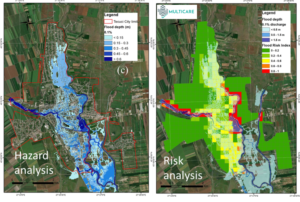
A digital data driven early warning system that:
- Enhances preparedness and minimises the impact of flash flood risks
- Integrates real-time river and rainfall sensors with European weather models
- Uses AI-assisted hydrological and hydraulic forecasting to predict flood scenarios
- Provides automatic alerts and visual dashboards for city operators and first responders
- Is designed with a modular structure enabling replication in other European cities exposed to flood and climate hazards

Learn more about MULTICARE.
MULTICLIMACT – CREMA Tool (Climate Resilience Maturity Assessment)
Innovation type: Software, System, Technology
Innovation development status: Under development, TRL6-7
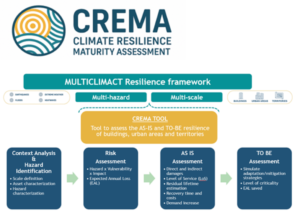
A climate resilience assessment tool that:
- Conducts comprehensive risk and resilience assessments across various scales, including buildings, urban areas, and entire territories
- Empowers decision-makers to evaluate the resilience of assets including cultural heritage sites, urban sectors, and regional amenities
- Applies probabilistic and deterministic risk assessment methods to evaluate potential threats, asset characterisation, vulnerability, and impacts
- Generates resilience scores and calculates Expected Annual Loss before and after resilience measures
- Translates damage into monetary losses to support cost-benefit analysis and intervention planning
Learn more about MULTICLIMACT.
Next steps
These innovations demonstrate how digital tools, early warning systems and decision-support platforms can strengthen climate resilience across Europe’s built environment, helping decision-makers better understand risks, plan effective interventions and protect communities.
STAR*track will continue to engage with EU-funded projects and expand this overview, highlighting practical, market-ready solutions and real-world applications as they emerge and mature across Europe