Help map R&I Gaps for the New European Bauhaus

NEB Junction, the NEB Hub for Results and Impact, has launched a survey to identify Research & Innovation gaps, implementation barriers and future priorities for the R&I component of the New European Bauhaus (NEB) Facility, as well as how it connects to the Roll-out component.

The primary purpose of this survey is to identify Research and Innovation gaps related to the R&I component of the NEB Facility, the funding instrument of the New European Bauhaus initiative. Furthermore, it aims to identify implementation barriers, future priorities for the NEB Facility and links between its R&I and Roll-out components.

The survey targets stakeholders involved in the New European Bauhaus Initiative, especially those from public administration and the construction sector. Other actors are encouraged to complete the survey as well. Your insights will contribute to recommendations for shaping the future NEB Facility.

The survey is especially keen to hear from the construction sector. Your input will directly feed into recommendations for shaping the future NEB Facility!

📝 Take the survey (~15-20 min): NEB Facility Survey

📅 The survey is open until 6 October
💡 Not familiar with the NEB Facility yet? Consult the NEB Facility factsheet first

Updates from the latest EU Innovation Finance Forum

What is the EU Innovation Finance Forum? 

The EU Innovation Finance Forum is a key element of STAR*track’s aim to facilitate access to finance opportunities and seeks to unlock private innovation finance in clean technology and new business models in the built environment, with a view to increase EU competitiveness. 

From first contact to funding 

The journey from identifying initial funding requirements to securing a tangible funding opportunity is rarely straightforward. Discussions in the EU Innovation Finance Forum showed that, when searching for an investor, understanding which type of funding best fits the company’s situation is crucial, as is finding the right match, building trust and improving readiness. 

Lessons learnt from the latest forum: 

Define the right funding need 

Forum discussions highlighted that innovators should identify what type of funding they need prior to approaching investors. 

Innovators often approach investors when they need new financing, but the term ‘private funding’ can mean different things, including debt, equity, blended finance, corporate-backed opportunities or public-private instruments. 

The message is clear: identify exactly what is needed before starting to look for funders. 

Targeted matchmaking matters 

Participants stressed that networking alone is ineffective when investors and innovators are not aligned on sector, geography, maturity or mandate. More selective, in-person formats were seen as valuable for building meaningful connections. 

Finding the right match is essential both for innovators and investors, but broad networking is not enough. Conversations are often poorly targeted, as innovators sometimes forget to research who they are addressing and why they want to be matched. This often leads to a mismatch in terms of mandate, geography, or sector focus. 

Participants of the Forum highlighted the importance of more selected formats, with a preference for in-person matchmaking: short one-to-one meetings, and clearer pre-selection.  

Trust is essential on both sides 

Even with the right matchmaking, mistrust can prevent effective communication on both sides and can ultimately become a barrier to financing. Founders may worry that investors will push them in directions misaligned with their vision to maximise profits, and investors may worry about unrealistic assumptions and a lack of credibility. 

Relationship-building skills, integrity and due diligence were all identified by forum members as key to overcome potential mistrust.  

Overinflated company valuations could also potentially be viewed as a red flag by investors, with the potential to damage trust and cause investors to back out. At the same time, trust must go both ways: investors also need to show that they can be reliable partners who support both the growth of the company and positive outcomes for their founders. 

Public and private finance can work together 

Public and private funding should not always be seen as opposing factors. In many cases, they can be combined as part of the innovation journey. There already exists an existing range of EU-level instruments that combine public and private logic.  

Programmes such as the EIC Accelerator, EIT Manufacturing, and other smaller initiatives can be a first step to help innovators move forward while preparing for private capital.  

The support of well-known institutions via accelerator participation, demonstrations with large corporations or public institutions and strong partnerships can all strengthen investors’ confidence.  

These signals do not replace due diligence, but they help show that a solution has already been tested or challenged in a meaningful way. 

To summarise 

The main lesson from this meeting of the EU Innovation Finance Forum was that private funding is not only about access to the funding itself; it is a journey that usually starts with a financing need but depends on trust, requires capacity building, and necessitates seeing the investors as partners. 

Funding discussions, therefore, can only begin with the right match, the right preparation, and enough trust to move forward.  

New European Bauhaus: become a member of the NEB junction stakeholder assembly

The call to constitute the New European Bauhaus (NEB) Junction Stakeholder Assembly is now open!

This assembly is designed as an inclusive space for public authorities, built-environment actors, cultural and creative professionals, civic organisations, researchers, community connectors, youth and emerging professionals, and many others who want to shape the future of the NEB in practice.

The NEB Junction Stakeholder Assembly aims to:

  • Connect local practices and experiments with the NEB Junction Hub
  • Assure that what works on the ground informs tools and policy
  • Help align different actors around shared priorities and next steps

It will produce recommendations that will be shared through the NEB Junction Hub, i.e., the web platform for disseminating NEB results.

You can find more information about the Assembly process and the application form here.


New video: three initiatives working together to transform Europe’s built environment

A new video has been released, providing an overview of how the Built4People Partnership, the Built4People Innovation Cluster (B4PIC) Network, and the STAR*track project work together to support sustainable transformation across Europe’s built environment. 

The Challenge 

Europe’s building stock is lagging in the green transition. To achieve complete decarbonisation by 2050, there is an urgent need to accelerate sustainable, people-centric innovation and bring innovative solutions to market more effectively. 

Three Interconnected Initiatives 

The video introduces three initiatives that form the basis of a comprehensive EU-funded approach to address this challenge:

The Built4People Partnership (2021-2027)

Built4People is a co-programmed public-private partnership between the European Commission and the European Construction Technology Platform (ECTP). The partnership aims to channel €400 million into research and innovation to increase collaboration and accelerate sustainable innovation across the built environment, aligned with New European Bauhaus values and principles. By strengthening cooperation between research, industry, and policy, Built4People works to enhance the competitive position of EU companies and bring innovative products to the European built environment.

The Built4People Innovation Cluster (B4PIC) Network

The B4PIC Network was initially established by the Nebula project to stimulate sustainable and people-centric innovation while boosting regional economies. The network brings together a community of regional Innovation Clusters, creating connections and facilitating knowledge exchange across borders. 

As of November 2025, the B4PIC Network spans over 20 European countries and continues to grow. The network aims to support the EU’s climate goals and create lasting sustainable impact throughout Europe and beyond by connecting innovators, researchers, businesses, and policymakers at the regional level.

The STAR*track Project (2024-2027)

The STAR*track project, coordinated by Nobatek/INEF4, continues and strengthens the work of developing the B4PIC Network. Running from May 2024 to April 2027, STAR*track has four primary objectives: 

  • Expand and strengthen the B4PIC Network by recruiting new Innovation Clusters and deepening collaboration among existing members 
  • Empower Innovation Clusters through targeted training and support on innovation processes and financial opportunities 
  • Provide innovation support to companies for product development, helping them navigate the path from concept to market 
  • Raise awareness among financiers and public authorities about the funding needs of innovative companies, and work to improve access to financing opportunities 

Working Together for Sustainable Impact

These three initiatives form an integrated ecosystem designed to support innovation, strengthen partnerships, and accelerate the transition to a sustainable and smart built environment that is accessible to all. 

Watch the video here.

Find partners for the upcoming NEB Facility calls!

The New European Bauhaus (NEB) Facility, part of Horizon Europe, aims to revitalise European neighbourhoods with design for sustainability and inclusion. It will support projects on the sustainable transformation of the built environment.

The Call 2025, deadline 12 November, covers three main areas, with specific topics, which are listed further below.

If you consider setting up a proposal for these calls, you will find in Partners for NEB calls 2025 a list of organisations (clusters, research organisations, consultants) that are interested to join, with specific expertise, experience and/or concrete cases in relation to each topic.

Views the list here: Partners for NEB calls 2025

Calls topics:

Connecting the green transformation, social inclusion and local democracy:

  • The impact of common space on neighbourhood communities
  • Fostering and maintaining the social fabric for the green transition in neighbourhoods
  • Beautiful, sustainable and inclusive street furniture for the transformation of neighbourhoods
  • Network of neighbourhoods for innovative policies on gentrification


Nebula Appoints NEB Advisors to Connect Local Innovation with the New European Bauhaus Initiative

The Nebula project has taken a significant step towards advancing the New European Bauhaus (NEB) initiative by appointing NEB Advisors, a group of experts in the European built environment. 

These advisors aim to connect local innovation networks with the resources and opportunities available via the Nebula project while supporting the broader NEB initiative.

The NEB is a 2021 initiative by the European Commission that aims to create sustainable, inclusive, and beautiful living spaces. It connects art, culture, science, and technology to support the European Green Deal’s goals of climate neutrality and resource efficiency. 

The NEB Advisors hope to promote the NEB values of beauty, sustainability, and togetherness. By linking national stakeholders in the built environment with the broader NEB framework, they aim to empower local networks and facilitate the sharing of key resources and insights across Europe.

Key responsibilities of the NEB Advisors include:

  • Disseminating the NEB Handbook to local networks as a key guidance tool on the NEB initiative.
  • Promoting Nebula’s peer-learning webinars and events, encouraging knowledge-sharing and collaboration.
  • Highlighting Horizon Europe (HE) funding opportunities for NEB-related projects within their networks.
  • Identifying local needs, such as financing, upskilling, and collaboration, and connecting these with the Nebula consortium.

The launch of the NEB Advisors represents a significant effort to strengthen the NEB initiative’s impact. Their work is expected to drive innovation and sustainability in the built environment, ensuring that the NEB initiative’s values continue to shape a sustainable and people-focused future for Europe. 

Click here to see the full suite of NEB Advisors.

Synthesis of the workshop’s outcome about implementing the New European Bauhaus in EU-funded projects now online

On September 24th in Luxemburg, the Nebula project organised the very first workshop dedicated to the New European Bauhaus (NEB) at the Sustainable Places Conference.

The objectives of the session were to raise awareness about the NEB amongst a mixed audience of experts from the built environment, question how they address the NEB value in their respective R&D projects, and identify the remaining challenges towards the further implementation of the new Bauhaus.

Participants discussed their perceptions, good practices, and remaining challenges with regards to implementing the NEB values (beautiful, sustainable, inclusive) and working principles (participatory approach, multi-level engagement, and transdisciplinary).

You can read the full synthesis of the participants’ exchanges following this link.

New Bauhaus Stories Episode #5: New European Bauhaus on Research & Education

The Nebula project is organising a series of peer learning activities to share experiences and insights about the New European Bauhaus. Join Nebula partners for the fifth instalment on 23 October 2024 to learn about the New European Bauhaus attitudes towards research and education.

Education and research were at the heart of the original Bauhaus School founded in 1919 by Walter Gropius in Germany. Many years later, the Bauhaus School inspired the New European Bauhaus (NEB) initiative, launched by the European Commission (EC) in 2021. In the Bauhaus spirit of combining art, science, industry and design, the NEB core values have been defined as ‘beautiful, sustainable, and together’, supported by the working principles of the participatory process, multi-level engagement, and a transdisciplinary approach. 

In Episode #5 of our New Bauhaus Stories webinar series , four NEB education and research projects (BAUHAUS4EU, NEBINAR, U-RE-HERIT, and Cultuur&Campus) will share their experiences, discuss how they incorporate NEB values and working principles into their activities, and explore the challenges and opportunities for NEB in research and education moving forward. 

BAUHAUS4EU is a European university alliance that aims to create a shared campus with joint teaching, research, and knowledge transfer activities to support the resilient, sustainable, inclusive, and beautiful development of their institutions and regions. 

NEBINAR is the New European Bauhaus ACE Initiative for young architects. The aim of the program is to disseminate knowledge about the NEB to a wide audience, especially young architects. The program specifically focuses on the Baltic and Balkan countries. However, the open formula of the program does not exclude the participation of organisations from other European countries. 

U-RE-HERIT’s ‘Architects for Heritage in Ukraine: Recreating Identity and Memory’ project focuses on the evaluation, preservation, and restoration of urban and architectural heritage in Ukraine during and after the war. It recognises this heritage as vital for fostering sustainable cultural, social, environmental, and economic recovery.

Cultuur&Campus is a sustainable hub that integrates arts, research, learning, and community, catalysing territorial transitions. 

You can learn more about the New Bauhaus Stories webinar series here.  

Date: 23 October 2024  

Time: 11:00-12:00 (CET) 

Click here to register

Recording of webinar with ‘NEB-by-design’ startups available!

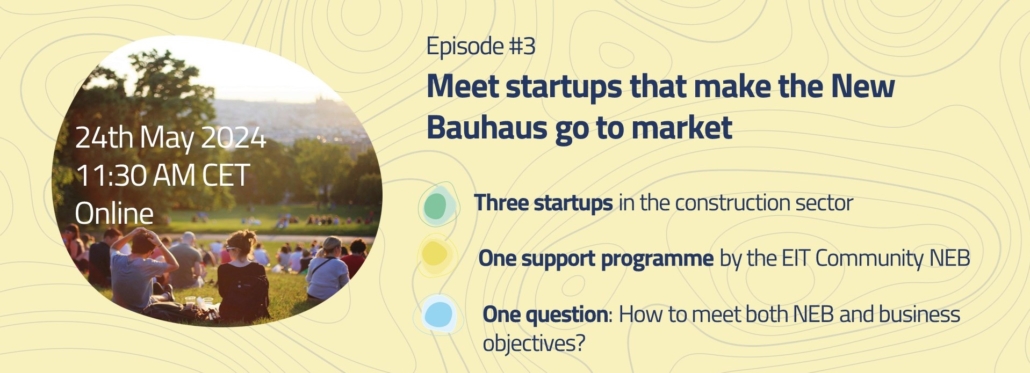
The recording of episode #3 of our webinar series “New Bauhaus Stories” is now available online here.

It addresses the following questions:

  • Is the New European Bauhaus (NEB) compatible with a business approach?
  • Can we develop solutions that both embed the inspirational values of the NEB (sustainability, beauty, inclusivity) whilst also appealing to a competitive market?

The session gathers three startups that developed ‘NEB-by-design’ solutions with the support of a dedicated mentoring and funding programme launched by the European Institute of Innovation and Technology (EIT) Community NEB.

Natalia Vera, Climate KIC, introduces the NEB Journey proposed by the EIT (European Institute of Innovation and Technology) NEB Community to support innovators and accelerate start-ups. Speakers from European start-ups that have developped ‘NEB-by-design’ solutions share their respective experience:

  • Geoffrey Eberle, ENTROPIC,  introduces the NEST solution from Spain, a façade panel technology that creates living spaces for plants and animals within the urban environment, while improving buildings’ acoustic and thermal performance.
  • Anastasya Syvolob presents GEODESIC.LIFE, a Ukrainian startup that commercialises affordable prefabricated eco-friendly dome homes.
  • Moujan Mahdian tells us about IMPERFECT (Belgium), an online platform enabling circular construction with streamlined audits of reclaimed materials and integrated environmental impact tracking.

The guest speakers then discuss the support available from a dedicated mentoring and funding programme launched by the EIT Community NEB and give recommendations for entrepreneurs interested in applying for this scheme.

New Bauhaus Stories Episode #4: let’s talk about renovation!

To achieve 2050 targets, buildings’ energy needs must be reduced massively to improve their energy performance in line with the Energy Efficiency First Principle. To that end, existing buildings need to transform into energy-efficient buildings, with a circular approach and a reduction of whole life-cycle carbon. But they also have to better answer occupants needs and account for social inclusion.

Several EU funded projects are currently developing and demonstrating solutions for the deep renovation of buildings, to unlock the EU Renovation Wave. They develop different types of innovative renovation packages, circular and digitalised approaches, as well as novel business models and marketplaces.

Episode #4 of our webinar series “New Bauhaus Stories” will give you the opportunity to meet 5 of those projects: REHOUSE,  Drastic,  e-SAFE,  InCUBE  and Fortesie while discussing how their innovations go beyond energy efficiency and embrace the values of the New European Bauhaus: sustainability, inclusiveness and aesthetics.

Date: June 4

Time: 12:00 CET

Registration link